

Why Site Investigations Are Critical Before Utility Connections
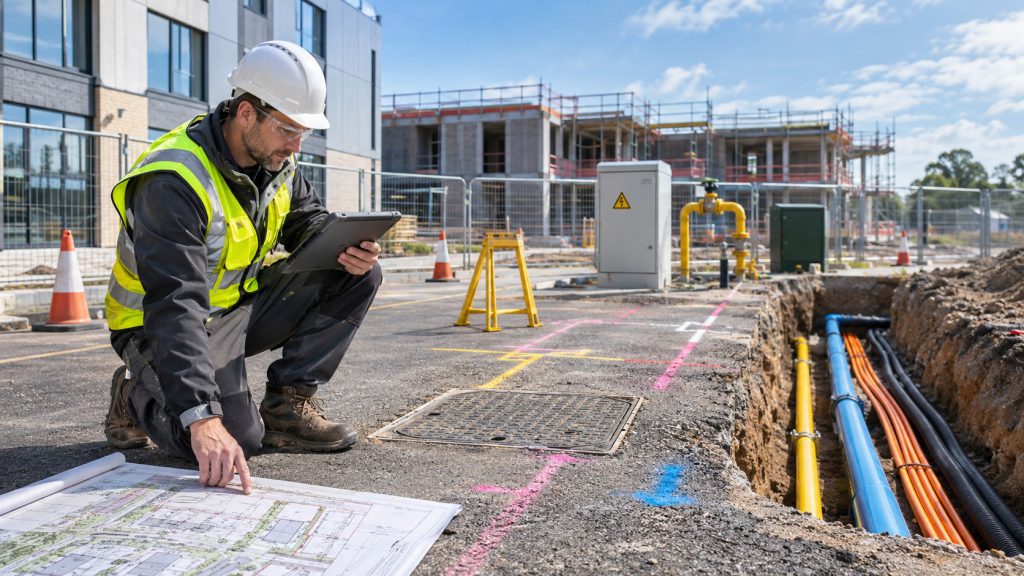
A new utility connection can look straightforward on a project programme: choose a route, complete the civil works and connect the premises. In practice, the condition of the site often determines whether that plan remains on schedule and within budget.
For developers and businesses operating multiple locations, early business site investigations provide the evidence needed to make sound decisions before designs, quotations and construction programmes become difficult to change. They can reveal buried infrastructure, unsuitable ground, access limitations and other risks that may affect a proposed gas or electricity connection.
What is a commercial site investigation?
A commercial site investigation is a structured assessment of the land, existing infrastructure and practical conditions that could influence development or utility work. The scope should reflect the proposed project, rather than rely on a generic survey that may not answer the design team’s key questions.
National Gas describes its Business Site Investigations as covering utility and infrastructure assessments, environmental and ground condition surveys, risk identification and detailed reporting to support planning and design decisions.
Depending on the site, the investigation may combine a review of available records with physical inspection, utility detection, route assessment and targeted ground investigation. A useful report should explain what was examined, what was found, which uncertainties remain and what action is recommended.
What site investigations can uncover
Existing underground services
A utility site investigation can identify the likely position and route of gas pipes, electricity cables, water infrastructure, drainage and communications services. This helps the project team assess whether the proposed connection route is practical and where additional precautions may be needed.
Records are a useful starting point, but they should not be treated as exact. HSE guidance explains that service plans provide only an indication of underground infrastructure. A competent person should use suitable locating equipment to trace and identify buried services before excavation begins.
Ground and environmental conditions
Ground conditions influence how connection work is designed and delivered. Made ground, unstable soil, groundwater, contamination, hard surfaces or previous construction can affect excavation methods, plant requirements and reinstatement.
Discovering these conditions after work has started may require a redesign, additional controls or different equipment. Identifying them early gives the commercial team a better basis for estimating costs, setting realistic timescales and allocating project risk.
Access and working constraints
A site may have enough physical space for a connection but still be difficult to work within. Restricted access, operating premises, delivery routes, public roads, neighbouring properties and limited working hours can all affect the installation method and programme.
An early gas site survey or electricity site survey allows these constraints to be considered before contractors arrive. It can also inform traffic management, work phasing and the safest position for trenches, equipment and connection infrastructure.
Conflicts with the proposed design
A preferred route on a drawing may conflict with existing services, foundations, drainage, landscaping or planned development. Meter positions and utility entry points may also be unsuitable once access and future maintenance requirements are considered.
Resolving these conflicts during design is generally more efficient than changing the route after excavation or building work has begun.
Common surprises that delay utility projects
One of the most frequent problems is incomplete information about existing services. Older sites may have been altered several times, and records may not show every redundant pipe, private cable or change in ground level.
HSE guidance for work near underground services is based on three essential elements: planning the work, locating and identifying buried services, and following safe excavation practices. All three are required to manage the risks effectively.
Other common problems include:
- Unrecorded services crossing the intended route
- Ground conditions that require different excavation methods
- Third party land, access or permission issues
- Roadworks and traffic management requirements
- A proposed route that clashes with ongoing operations
- Late changes to the required gas or electricity capacity
- Meter or equipment locations that do not provide safe access
Each issue can affect the design, permissions, cost and availability of contractors. When several are discovered after a quotation has been accepted, the combined impact can be substantial.
How site investigations reduce cost overruns
Site investigations cannot remove every uncertainty, but they make important risks visible earlier. This allows developers and business decision makers to price and programme the work on a more informed basis.
A well scoped investigation can support a more practical connection route, improve civil engineering estimates, identify specialist equipment before mobilisation and allow permissions or access arrangements to begin sooner.
It can also reduce:
- Redesign during construction
- Repeat contractor visits
- Delays caused by unexpected obstructions
- Emergency stoppages following damage to existing services
- Variations to the original quotation
- Extended plant and labour costs
- Disruption to operating areas of the business
For organisations operating several properties, consistent nationwide business site investigations can improve governance. Using a defined scope and reporting structure makes it easier to compare risks, prioritise projects and plan investment across a property portfolio.
When are investigations legally or commercially necessary?
There is no single rule requiring every utility project to use the same investigation package. The appropriate scope depends on the site and the proposed work.
However, UK health and safety duties require construction risks to be identified and managed. HSE guidance says that project teams should gather information about the site before work begins, including details of underground services, unusual ground conditions and nearby roads or activities. Where excavation could affect buried infrastructure, the work must be planned, services must be located and identified, and safe digging practices must be followed.
Commercially, a site investigation should be treated as essential when:
- The project involves excavation or work near buried services
- Existing utility records are incomplete or uncertain
- The property is a brownfield, industrial or previously redeveloped site
- The proposed route crosses operational or public areas
- The opening, handover or production date is commercially critical
- A high capacity or technically complex connection is required
- Several utility projects need to be coordinated
- A business is acquiring a site and needs to understand development risk
The earlier these questions are addressed, the easier it is to incorporate the findings into design, procurement and the construction programme.
Site investigation before a gas connection
For a commercial gas connection, the investigation may inform pipe routing, excavation planning, site access and the location of associated metering infrastructure.
It can also help the project team understand how the connection work may affect existing operations, vehicle movements and access to neighbouring areas. National Gas states that its commercial gas connection service covers planning, applications, installation, final handover and coordination with network operators.
Site investigation before an electricity connection
For a commercial electricity connection, the investigation may identify buried cables, access requirements, route restrictions and conflicts with other services.
The findings should be coordinated with capacity planning and the requirements of the relevant network provider. This is particularly important for larger commercial or industrial developments where the connection may require substantial infrastructure or more complex civil works.
National Gas’s commercial electricity connection service covers planning, applications, technical requirements, installation and final activation.
In both gas and electricity projects, the investigation should be completed early enough to influence the design, not simply used to confirm a route that has already been fixed.
What should decision makers expect from the report?
A useful investigation report should be clear enough for developers, project managers and contractors to act upon.
It should normally:
- Define the survey area and investigation methods
- Record identified utilities and infrastructure
- Describe relevant ground and environmental conditions
- Highlight access and construction constraints
- Explain the limitations of the available information
- Present the principal project risks
- Recommend practical next steps or further investigation
Decision makers should also confirm that the scope matches the intended utility work. A desktop review may support an early feasibility assessment, but it is not automatically a substitute for on site detection or targeted investigation before excavation.
Plan your utility project with better information
A delayed utility connection can affect construction sequencing, contractor costs, tenant handover, site opening and revenue. Business Site Investigations reduce that exposure by identifying constraints before they become problems on site.
National Gas provides commercial site investigation services across the UK, including utility and infrastructure assessments, ground condition surveys, risk identification and reporting for commercial developments.
Request a commercial site investigation
Planning a new development, site expansion or utility connection?
Explore our Commercial Site Investigation service and request a free, no obligation quote. If your project also requires a new supply, involve the connection team early so the investigation, design and delivery programme can be coordinated from the outset.
Suggested internal anchor texts
| Anchor text | Destination |
| business site investigations | Commercial Site Investigation page |
| commercial site investigation services | Commercial Site Investigation page |
| commercial gas connection | Commercial Gas Connections page |
| commercial electricity connection | Commercial Electricity Connections page |